What's happening to software engineers?
 Sam Xifaras
Written for General, mildly technical, audience
I'm trying something new: posting looser, less edited streams of thought so I can get more posts out quicker. Feedback? Let me know at s.xifaras999@gmail.com.
In late 2022, ChatGPT was released, and this has since snowballed into the largest economic bet in the history of the United States. If you had asked me then whether I thought software engineering might be automated, I might have said "probably, but not for a while, and not before many simpler white-collar tasks."
Many of us probably thought similarly, but as it turns out, it might be the thing that AI is best at. And there are a few good reasons for it:
- There is a lot of training data
- The industry has generally converged on well-known and accepted patterns and principles for system design
- Revelant annotations, comments, discussions and other metadata about software are more likely to be on the internet and in a computable form than in other industries
- There are very clean reward signals: the build fails, tests fail, an API call is failing, etc.
Today, the New York Times reported on the "verification tax" of AI-assisted work. I think this is an underappreciated limiting factor on how much more economic growth we can really squeeze out with AI; if we truly want to unlock extreme productivity gains, we need to be able to 1) actually have the AI doing just as good or better than humans, and 2) be able to trust the AI to do the job well in a variety of situations. Perhaps the case is different in industries across the economy, but in software, I have found that both of these criteria are satisfied, depending on the quality of the task definition.
As I recently wrote about in my
announcement of ruby-lean, I
ended up having to scrap many thousands of tokens' worth of development work
several times. However, I was able to get the agents to perform really well when
I imposed a rigid structure of how trustworthy progress can be made. And
throughout the entire project, agents have performed far better than me at
writing Lean proofs that check and conform to the rules I impose.
So, in pure software domains like
ruby-lean, at least, I have been able
to unlock superhuman progress. This extends to my day job at Stripe as well.
Stripe, along with every other large tech company, are implementing their own
software factories,
where agents autonomously define implementation plans, write code, test it,
review it, get it merged, and monitor it in production. Humans move a level up,
setting the direction. Gergeley Orosz posted about
OpenAI's
software factory. Different companies are at different levels on the scale of
full factory production of software; it makes sense that the frontier labs like
OpenAI and Anthropic would be at the forefront. Anthropic
claims that as
of May 2026, 80% of code that gets merged into the codebase is authored by
Claude.1
In other domains, similar gains can be made by implementing a scaffold of checks and balances that build robust monitoring frameworks and compounding trust as a result.
All this is to say that productivity gains from AI are real, and improving, even if they have not diffused throughout the economy yet. Because the feedback loop of software engineering is so tight, and because new training data gets generated every day as coding agents are extensively used by software developers around the country and world, I expect the productivity gains will continue to increase.
What does this mean for software engineers?#
Software engineering is already in a precarious position. Software engineering job postings on Indeed in the US are up compared to last year around this time, but still down tremendously from the boom years around the pandemic. Furthermore, The Pragmatic Engineer reports that just 1 in 10 software engineering hires is a new graduate, down from 1 in 3 in 2023. The number of computer science graduates also has peaked this year, meaning that more new CS graduates than ever are entering a market that is getting automated away, with an eroding salary premium. The same linked article reports that enrollment in other STEM professions like engineering and finance are increasing now, with computer science likely to be on a steep downward trajectory as the salary premium erodes and agents get better at it.
I think this is just the beginning. Entry level work will of course be the first to get automated, and it largely already is; I find myself being able to close out bug tickets within an hour or less by delegating an agent to it, whereas last year I might have assigned that ticket to a new hire as a task to help them get ramped up with the code. So not only are entry level roles harder to get hired for; once hired, there are fewer opportunities to develop skills that would get a junior engineer to the next level.
As AI capabilities improve, I believe this will spread upwards towards the higher levels of the engineering career ladder. In the short term, there will be insane unmet demand for senior engineers who can steer the agents with a refined understanding of the code so that the system grows sustainably...until the agents develop that refined understanding.
Here is how I picture it playing out: not one cliff, but a series of phase-delayed waves.
range: 2023-01 | 2030-07
today: 2026-10
spike: 2025-01 | 2026-04
caption: An illustrative model, not data. Mouse over the chart to get a sense of how I'm thinking about this.
tier: Entry level | 2026-12 | 8
tier: Mid level | 2027-08 | 12
tier: Senior | 2028-03 | 16
tier: Staff | 2028-11 | 20
note: 2023-01 | all | Before the spike | Each line is one level of the career ladder, indexed to its own peak (100). Early models assist engineers more than they replace any of them.
note: 2025-01 | all | Unmet demand spikes | Agents make software dramatically cheaper to build, so companies want to build far more of it, and they need engineers at every level to steer the agents. This is the *insane unmet demand* of the short term.
note: 2026-08 | 0 | Entry level falls first, and fastest | The work handed to new grads is precisely scoped and specified. AI is best at this kind of work. Entry-level demand drops off a cliff. The starter tickets that used to ramp new hires up go to agents in companies' software factories instead.
note: 2026-10 | all | Where we are today | Everything to the right of this line is projection (dashed). Demand is still near its peak at most levels, but entry level has started to fall.
note: 2027-02 | 1 | Mid level follows | About eight months behind, mid-level demand falls, a little less steeply. Coding agents reliably ship multi-file features, and fewer juniors are being promoted into this tier because it becomes progressively harder to keep up with agents that can do simple tasks better and faster.
note: 2027-07 | 2 | Senior falls once agents can maintain and refactor | Senior engineers ship complex, impactful projects and deeply influence the code's design and evolution. As AI develops a similarly refined understanding, with scaffolding to provide agents inputs from GTM and observability systems to drive product engineering direction, senior demand falls too.
note: 2027-12 | 3 | Staff holds out longest | Setting technical direction across many systems is the hardest thing to hand off, so staff demand falls last and slowest. But it still falls as agents earn trust.
note: 2029-06 | all | Near zero by 2030 | By 2030, demand at every level is close to zero. What is left is a small group of people who set direction, define tasks precisely, and own the trust that lets everyone else rely on the agents' work.
A few things could invalidate this theory. First, AI capability improvement could plateau, though I find this unlikely. Second, harkening back to my first blog post, AI could get more expensive as capital infused into effective inference subsidies dries up, growth in AI output quality could also stall due to thinning R&D budgets, or growth in inference speed/compute availability could stall. Finally, I think the most underappreciated risk is macro risk. COVID-19 demonstrated how quickly and easily our supply chain can be shocked. The Iran war continues to keep energy prices in flux. A larger-scale global conflict could put a pause on advanced AI development indefinitely.
But at that point, we have way bigger things to worry about than the job market for software engineers...
What does this mean for the software/SaaS economy?#
The important quantity is
Read: the ratio between output Quality and the product of Cost and Time it takes to produce the amount of tokens required to achieve an average task. This is pretty hand-wavy and deserves a much more rigorous analysis, but as a simple starting point I think it suffices. I dub it the "build payoff."2
Build payoff, as the name suggests, controls the "build-vs-buy" tradeoff. If cost of tokens and time to generate them asymptotically approaches zero, while quality holds steady or increases, even at current frontier capability levels, this dramatically shifts the calculus away from purchasing SaaS products that other companies are making, and towards building everything in-house. But this is an idealized scenario. In reality, the cost and time consumed by inference for tokens will remain elevated for some time, and this means that SaaS companies will continue to capture the value of the agentic software factory boom: agents and their "steerers" will decide that it is better to buy an observability platform (that other agents are building and maintaining, under the direction of the shareholders).
You may wonder: how can build payoff be measured? Quality can be measured in a few ways. One that jumps to mind is METR's task horizon benchmark, although the latest update to their webpage notes that measurements of task horizon length above 16 hours are "unreliable" with their current set of benchmark tasks. Another way might be the number of "successful" agent rollouts, as measured by Anthropic in their recursive self-improvement post. Cost and time are more straightforward. These are measured already on platforms like Arena and OpenRouter.
The build payoff is still being held down mainly by cost. Heavy AI use can rack up bills upwards of several thousand dollars a month. Anthropic's models are notoriously expensive and slow as well, with OpenAI models currently favored for their lower cost and higher inference speed. The quality does continue to rise, however.
I think it is pretty safe to conclude that cost won't come down soon too. Anthropic recently filed for IPO with financies that indicate a staggeringly high operating loss, almost twice its revenue.
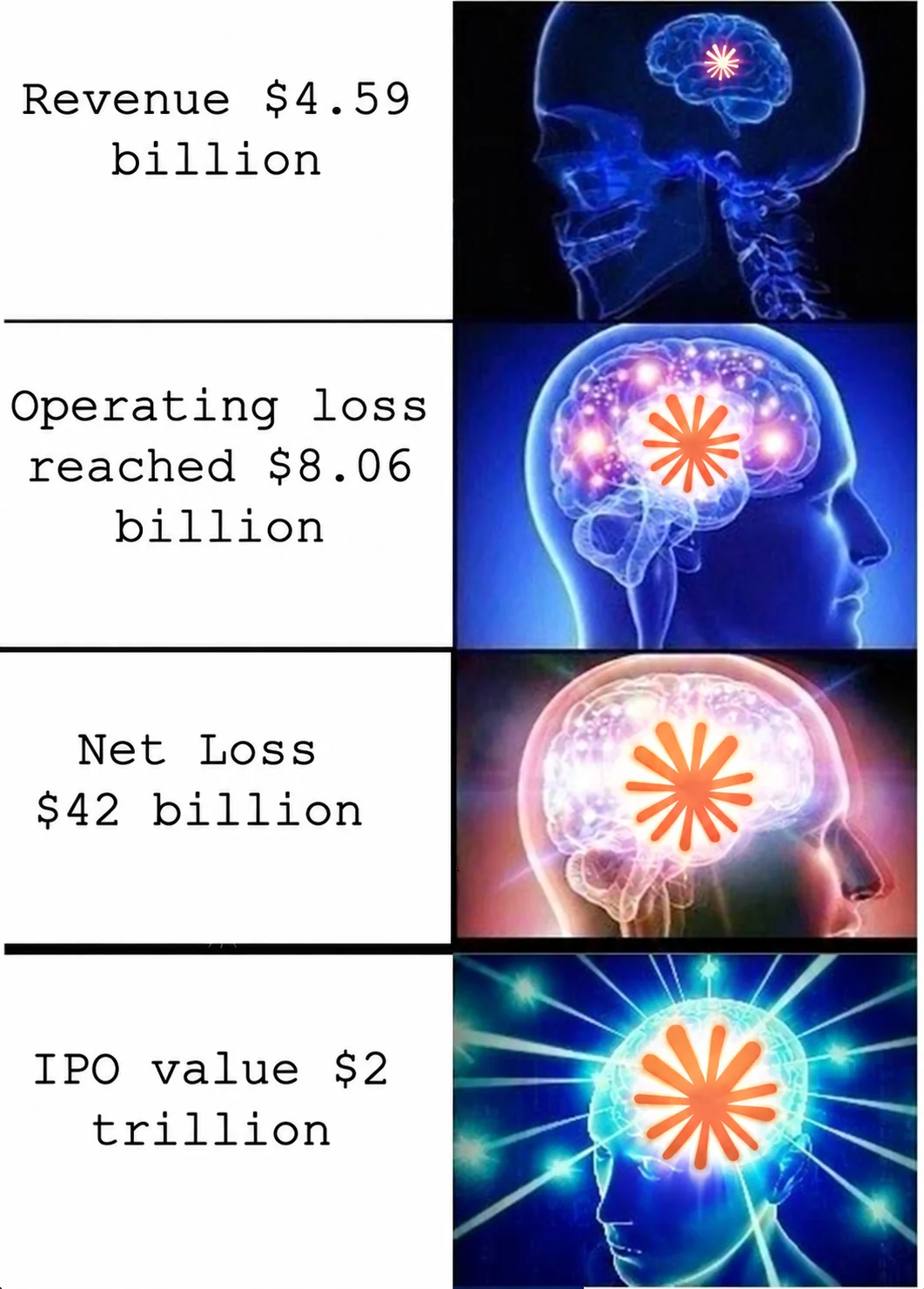
Put another way, building software that meets a user need will still require risk, capital outlays, and a business model. I think this is why we are observing a RenaiSaaS, contrary to investors' fears of a "SaaSpocalypse" at the beginning of this year. Don't get complacent though. As the build payoff increases, value will cease to be captured by SaaS companies, because it will become so much easier to build complex things quickly.
How to prepare#
Honestly, I'm still trying to figure this one out. A part of me hopes what I'm anticipating here doesn't come to fruition, but I am not holding my breath. I feel that the writing is already on the wall.
Here are a couple principles I'm trying to align around right now:
- Do what you love. Easier said than done, given your financial standing, but if you're able, find a way to work on something you're truly, differentially passionate about. I'm hoping to take my career in this direction soon.
- Stay human. Build rich social networks, and maintain critical, nuanced, thought in the face of an AI slop firehose.
Thank you, dear reader, for getting this far. Stay well and safe!